No fake follower checker can prove that an Instagram account's followers are fake. Only Instagram can see the login, device and behavior data that separates a bot from a quiet real person. What you can do from the outside is check 7 public red flags: engagement far below the account's size tier, very few comments per 100 likes, average likes far above median likes, sudden follower jumps, generic comments, empty-looking follower profiles and a following count that dwarfs the follower count. In Instapect's audit data, 66 of 141 public accounts (47%) tripped at least one flag, including @nike and @natgeo. A flag tells you where to look, not what is fake.
This guide shows how to run each check by hand, what fake follower checker tools actually measure, how to clean spam followers from your own account, and how to read the result without accusing a real creator of fraud.
Disclosure: Instapect publishes this guide and makes one of the tools mentioned below. Instapect is not a fake-follower detector. It measures public signals only (posts, visible likes and comments, follower count, and follower change between its own snapshots). Every method here works without it: you need a calculator, a spreadsheet and ten minutes.
Key takeaways
| Question | Short answer (October 2026) |
|---|---|
| Can a fake follower checker prove followers are fake? | No. Checkers estimate from a sample of follower profiles or from engagement patterns. The FTC's consumer alert on fake followers says: "Truth is, you can't be sure" (October 21, 2019) |
| What is the biggest public red flag? | Engagement rate far below the median for the account's follower tier. In Instapect audits the median for 10K to 100K accounts is 0.37%; under 0.13% puts an account in that tier's bottom quarter |
| How many comments per 100 likes is normal? | It depends on size: median 7.8 under 1K followers, 3.3 for 1K to 10K, 5.7 for 10K to 100K, 3.0 for 100K to 1M, 1.1 for 1M+ (141 accounts) |
| Do real accounts trip red flags? | Often. 47% of audited accounts tripped at least one of three numeric flags and 11% tripped two or more, @nike and @natgeo among them |
| How do I remove fake followers from my own account? | Instagram filters likely spam into a Potential spam list in your Followers tab, with a Remove all spam followers button (Instagram Help Center, checked October 12, 2026) |
| Is buying fake followers illegal? | In the US, the FTC rule effective October 21, 2024 bans buying or selling fake indicators of social media influence when the buyer knew or should have known they were fake and uses them to misrepresent influence for a commercial purpose |
Can a fake follower checker tell if Instagram followers are fake?
A fake follower checker gives you an estimate, not a verdict. The tools that rank for "fake follower checker instagram" work in one of two ways.
1. Follower sampling. The tool pulls a sample of the account's followers and classifies each profile. Modash, for example, says it "analyzes a sample of a creator's followers and sorts each account into one of five types: real people, mass followers, influencers, suspicious accounts, and bots," and defines the fake follower rate as suspicious accounts + bot accounts (Modash fake follower checker page, retrieved October 12, 2026). Mass followers (real people who follow tens of thousands of accounts) are counted separately.
2. Engagement and growth modeling. HypeAuditor's free checker returns an Audience Quality Score from 1 to 100 based on "engagement rate, quality audience, follower growth, and engagement authenticity," and lists the following-to-followers ratio, likes-to-comments ratio and engagement rate among its inputs (HypeAuditor free Instagram fake follower check, retrieved October 12, 2026). HypeAuditor states that its model "detects over 95% of all fraudulent activity." That is a vendor claim; no independent audit of it is published.
Both approaches share three limits:
- The classifier only sees public profile traits. A real person with no profile photo, no posts and a random username looks exactly like a bot.
- The sample is small next to the follower count. Modash's own example shows 10,000 followers analyzed. On a 2M-follower account that is 0.5% of the audience.
- Different tools disagree. The top organic result for this keyword on October 12, 2026 was a Reddit thread in r/influencermarketing titled "What are some legit tools to calculate fake follower..." where the poster says every site gives "random values" for micro influencers.
Instagram itself is the only party with the login, device, IP and behavior data to call an account fake, and it acts on that data directly. On November 19, 2018 Instagram announced it would begin "removing inauthentic likes, follows and comments from accounts that use third-party apps to boost their popularity," using machine learning tools. Its Help Center page "Types of accounts that are removed from Instagram" says spam and fake accounts "may be removed."
So treat any percentage a checker shows as a starting point for the manual checks below.
How to check fake followers on Instagram: the 7-step public method
You need the account's follower count, its last 12 regular posts (skip pinned posts, which collect engagement for months) and a spreadsheet. Write down likes and comments for each post. If likes are hidden on some posts, leave those posts out of the like-based checks.
Step 1: Compare engagement rate with the account's size tier
Formula: engagement rate by followers = (average likes + average comments) ÷ followers × 100.
Engagement falls as accounts grow, so compare an account only with accounts of a similar size. These are the medians and bottom-quarter cut-offs from 141 public accounts Instapect audited between August 28 and October 11, 2026:
| Follower tier | Accounts | Median engagement rate | Bottom 25% starts below |
|---|---|---|---|
| Under 1K | 24 | 13.96% | 5.59% |
| 1K to 10K | 28 | 2.75% | 1.28% |
| 10K to 100K | 23 | 0.37% | 0.13% |
| 100K to 1M | 20 | 0.30% | 0.08% |
| 1M+ | 46 | 0.53% | 0.11% |
Red flag: engagement in the bottom quarter of its tier. A 40K-follower account averaging 30 likes (0.08%) fits that.
Innocent explanations: an old account whose audience has drifted away, a brand page that posts product shots, a recent switch away from the content that built the following. For the full benchmark tables see what is a good engagement rate on Instagram, and for the formula step by step see how to calculate Instagram engagement rate.
Step 2: Count comments per 100 likes
Formula: comments per 100 likes = total comments ÷ total likes × 100.
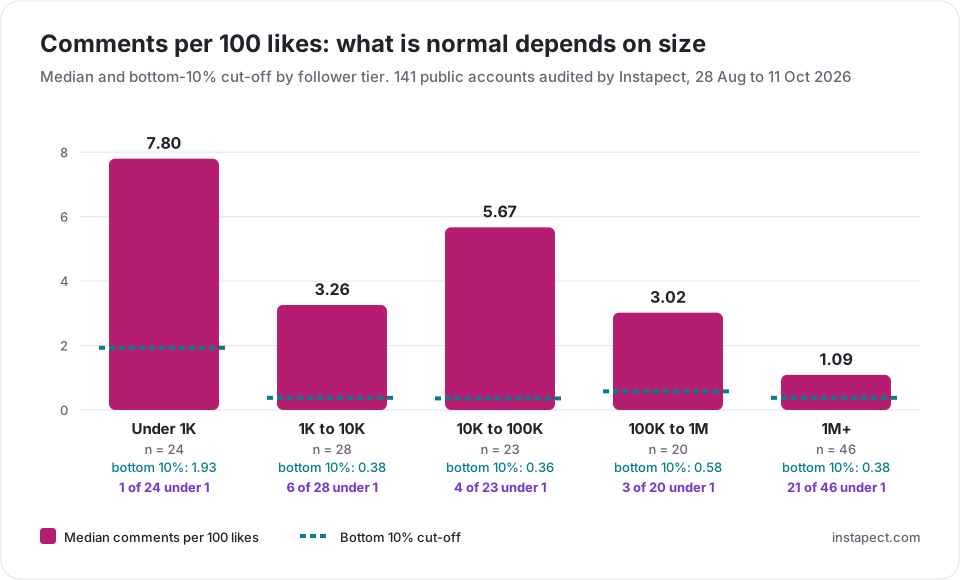
Bought likes are cheap; believable comments are harder to fake at scale. Very few comments relative to likes is a classic sign of purchased likes. The catch: comment ratios drop naturally as accounts get bigger.
| Follower tier | Median comments per 100 likes | Bottom 10% below | Accounts under 1 per 100 |
|---|---|---|---|
| Under 1K | 7.80 | 1.93 | 1 of 24 |
| 1K to 10K | 3.26 | 0.38 | 6 of 28 |
| 10K to 100K | 5.67 | 0.36 | 4 of 23 |
| 100K to 1M | 3.02 | 0.58 | 3 of 20 |
| 1M+ | 1.09 | 0.38 | 21 of 46 |
Red flag: a ratio in the bottom 10% of the account's tier, for example under 0.4 comments per 100 likes on a 20K-follower account.
Innocent explanations: comments turned off or limited (the ratio drops to near zero), celebrity scale (21 of the 46 accounts with 1M+ followers sat under 1 comment per 100 likes), giveaway posts that pull likes from outside the usual audience.
Step 3: Compare average likes with median likes
Formula: skew = average likes ÷ median likes.
The median is the middle post. If the average sits far above it, a few posts carry the account. That happens when an account buys likes on selected posts, and it also happens when one Reel goes viral.
Red flag: average likes at least 2x the median, with the high posts showing few comments or comments that read like Step 5.
What the data says: across 141 audited accounts the typical skew was 1.39x. 32 accounts (23%) had an average at least 2x the median and 62 (44%) at least 1.5x. Skew is common, so it only matters next to another flag. The engagement rate calculator shows average and median side by side for any public account.
Step 4: Look for sudden follower jumps between snapshots
Instagram publishes no follower history. You need two or more follower counts taken on different dates: your own screenshots, a tracker such as Social Blade, or a tool that records snapshots each time it audits an account (Instapect does this and charts the change on the report page).
Formula: growth between snapshots = (new followers − old followers) ÷ old followers × 100, then divide by the days between snapshots for a daily rate.
Red flag: a step jump (thousands of followers in a day or two) with no matching viral post, press mention, collaboration or giveaway, often followed by a slow decline as Instagram purges inauthentic accounts.
Be honest about the limits. Instapect's own snapshot table is too thin to set a "normal growth" threshold: as of October 12, 2026 it held 384 snapshots across 310 accounts, and only 3 pairs were at least a day apart. One of those pairs, a business account under 1K followers, grew 40% in 21 days (768 to 1,077). That could be a launch, a paid campaign, a giveaway or bought followers. The number alone cannot say which.
Step 5: Read the comments, not just the count
Open the comments on the last 5 to 10 posts and look for:
- generic praise that fits any post ("Nice pic", "Great content", "Love this 🔥"),
- emoji-only strings repeated across posts,
- the same handful of accounts commenting first on every post within minutes (a sign of an engagement pod),
- commenters with no profile photo, few posts and usernames that end in long digit strings,
- promotional replies ("DM us to collaborate", "Send pic to @...").
Red flag: most comments are generic or come from the same small group, and almost none respond to what the post actually says.
Innocent explanation: large accounts attract spam comments they did not buy. Look at the share of real replies, not the presence of spam.
Step 6: Spot-check 20 follower profiles
Open the follower list (it is visible on public accounts) and tap 20 profiles spread through the list, not just the top. Note how many have no profile photo, zero posts, a following count in the thousands with a handful of followers, or a username like "name_83920174".
Red flag: a large share of the sample fits the bot pattern. This is the same idea as Modash's follower sampling, done by hand on a smaller sample, so treat it as rough.
Innocent explanation: many real people never post. Brand and celebrity accounts collect empty-looking followers they never asked for.
Step 7: Check the account's own following count
Red flag: the account follows thousands of people and has a similar or smaller follower count, with recent bursts of follows. That points to follow-for-follow tactics, which HypeAuditor lists among the "shadow methods of growth" it screens for.
Innocent explanation: some community accounts and small businesses follow back everyone on purpose.
Verify: score the result before you decide
Count the flags from Steps 1 to 7. Then use this rule of thumb:
| Flags tripped | What it usually means | What to do |
|---|---|---|
| 0 to 1 | Normal. Nearly half of audited accounts trip at least one | Move on; judge the content and audience fit |
| 2 to 3 | Worth a closer look | Ask the creator for an Insights screenshot (reach, views, audience location) and a past campaign result |
| 4 or more, including Step 4 or Step 6 | Strong sign of inauthentic growth or engagement | Ask for Insights screen recordings, run a paid checker for a second opinion, or skip the deal |
Insights data is owner-only, so the creator is the one person who can show you reach, views and audience location. Our guide on how to see Instagram Insights shows them exactly where to tap.
Fake follower red flags at a glance
| Signal | How to measure it | Red flag | Common innocent cause |
|---|---|---|---|
| Engagement vs tier | (avg likes + avg comments) ÷ followers × 100 | Bottom 25% of the tier | Aging audience, brand-style content |
| Comments per 100 likes | comments ÷ likes × 100 | Bottom 10% of the tier | Comments off, celebrity scale |
| Average vs median likes | avg likes ÷ median likes | 2x or more | One viral Reel |
| Follower jumps | Change between dated snapshots | Step jump with no event | Press, collab, giveaway |
| Generic comments | Read 5 to 10 posts | Mostly generic, same commenters | Big accounts attract spam |
| Empty follower profiles | Sample 20 followers | Many with no photo, no posts, digit usernames | Real lurkers |
| Following count | Following vs followers | Follows thousands, bursts of follows | Follow-back policy |
What Instapect's data shows: red flags fire on real accounts
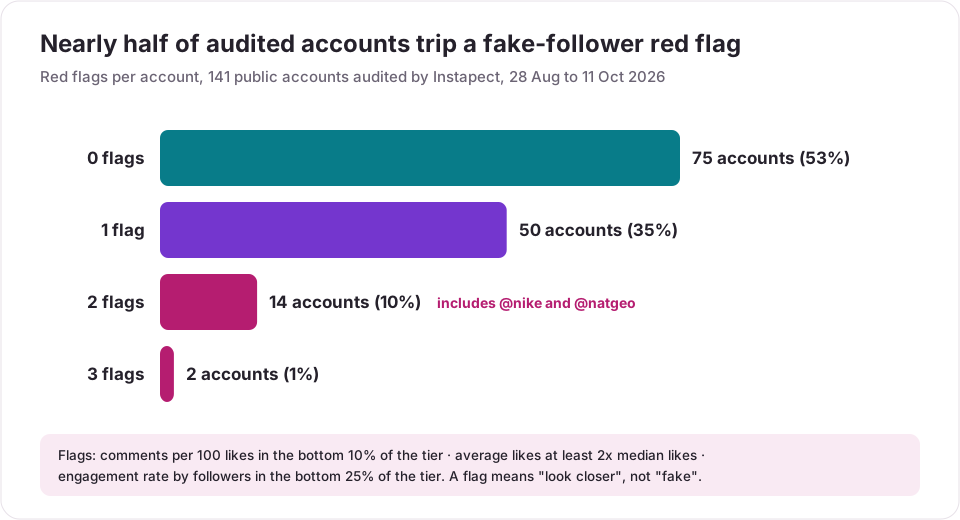
Method. We took every public report in Instapect's audit cache fetched between August 28 and October 11, 2026 that met the quality bar: at least 6 usable posts, no hidden like counts in the sample, followers above zero, not delisted. That left 141 accounts. For each account we applied three numeric flags from the steps above, using the account's own follower tier as the baseline:
- comments per 100 likes in the bottom 10% of the tier,
- average likes at least 2x median likes,
- engagement rate by followers in the bottom 25% of the tier.
Result.
| Flags tripped | Accounts | Share |
|---|---|---|
| 0 | 75 | 53% |
| 1 | 50 | 35% |
| 2 | 14 | 10% |
| 3 | 2 | 1% |
| At least 1 | 66 | 47% |
Two of the accounts with two flags are household brands:
| Account | Followers | Engagement rate | Avg likes vs median | Comments per 100 likes | Retrieved |
|---|---|---|---|---|---|
| @nike | 291.3M | 0.06% | 170,650 vs 68,111 (2.5x) | 0.58 | September 5, 2026 |
| @natgeo | 268.7M | 0.03% | 76,619 vs 36,374 (2.1x) | 0.57 | August 28, 2026 |
Both are long-running brand accounts with enormous followings, and huge audiences include many people who followed once and rarely react now. Low engagement and a skewed like count fit that pattern at least as well as they fit fake followers. Even @instagram tripped one flag. For a clean comparison, @nasa tripped none.
What this means for you: a single flag is noise. Two flags justify questions. Only a cluster that includes the follower-level checks (jumps, empty profiles) starts to look like a pattern, and even then the creator's Insights are the tiebreaker.
Limits. These 141 accounts are the ones people chose to audit on Instapect, so they lean toward well-known accounts and accounts someone was curious about. Some tiers hold only 20 to 28 accounts. The like and comment counts come from the most recent public posts at the time of each audit, and the follower-level checks (Steps 4 to 7) are not in the dataset. None of this is evidence that any named account has, or does not have, fake followers.
How to check your own account for fake followers
If you want to clean your own follower list, Instagram does the heavy lifting. According to the Instagram Help Center page "How to remove spam or bot followers on Instagram" (checked October 12, 2026), accounts that are likely to be spam "can't follow you without your confirmation" and are filtered into a separate list.
Review potential spam followers:
- Tap Profile or your profile picture in the bottom right.
- Tap your follower list, then tap Potential spam.
- Tap Confirm to approve an account or Delete to deny it.
Remove all of them at once: in the same Potential spam list, tap Remove all spam followers, then Remove. Instagram says it won't tell those accounts they were removed.
Turn the filter on or off: Profile > Menu > Settings and privacy > Followers > toggle Filter spam followers.
To remove a single follower by hand: open your follower list, tap the X next to the account, then Remove. Expect your follower count and possibly your engagement rate to shift after a cleanup; that is the point.
Fake follower checker tools compared
| Tool | How it judges followers | Cost (checked October 12, 2026) | What it cannot do |
|---|---|---|---|
| Modash fake follower checker | Classifies a sample of followers into real, mass followers, influencers, suspicious and bots; fake rate = suspicious + bots | Free, no sign-up | Prove any single follower is fake; sample is a fraction of large audiences |
| HypeAuditor free fake follower check | Audience Quality Score (1 to 100) from engagement, audience quality, growth and engagement authenticity | Free check; full reports paid | Show its model; the 95% detection figure is self-reported |
| Instagram Potential spam filter | Instagram's own spam signals, for your account only | Free, built in | Show anything about someone else's account |
| Manual 7-step method (this guide) | Public signals compared with tier benchmarks | Free | See follower-level data at scale |
| Instapect | Engagement by followers, average vs median, comments per 100 likes, follower change between its own snapshots | Free summary report | Detect or count fake followers. It is not a fake-follower detector |
If you need a fake-follower percentage, use a sampling tool and treat the number as an estimate. If you need to judge whether an audience reacts to a creator's content, the public engagement checks tell you more per minute spent. Our comparison of Instagram analytics tools covers the wider set of tools with prices.
Is buying fake followers illegal?
In the United States, it can be. The FTC's Trade Regulation Rule on the Use of Consumer Reviews and Testimonials, announced on August 14, 2024 and effective October 21, 2024 (Federal Register, August 22, 2024), "prohibits anyone from selling or buying fake indicators of social media influence, such as followers or views generated by a bot or hijacked account." The FTC limits that ban to cases where the buyer "knew or should have known that the indicators were fake" and uses them to misrepresent influence or importance "for a commercial purpose."
Before the rule, the FTC settled charges in October 2019 against Devumi, which sold fake followers, subscribers, views and likes; the order banned the company from selling social media influence. Instagram's Terms of Use and Community Guidelines also forbid third-party apps that generate inauthentic likes, follows and comments, per its November 19, 2018 announcement.
This is general information, not legal advice. Rules differ outside the US.
Frequently asked questions
Is there a free fake follower checker for Instagram?
Yes. Modash and HypeAuditor both offer free checks on public Instagram accounts as of October 12, 2026, and Instagram's built-in Potential spam filter is free for your own followers. Free checkers give estimates from samples or engagement models. Use the 7 public red flags in this guide to sanity-check whatever number they show.
How accurate are fake follower checkers?
Nobody outside Instagram can measure their accuracy, because there is no public list of which accounts are truly fake. Tools often disagree on the same account, especially for micro influencers. HypeAuditor's "over 95%" detection figure is self-reported. Treat any fake-follower percentage as an estimate with a wide margin.
How do I check if someone has fake followers on Instagram for free?
Take their last 12 regular posts and work out engagement rate by followers, comments per 100 likes, and average likes divided by median likes. Compare each with the tier tables above. Then read comments on 5 to 10 posts and spot-check 20 follower profiles. Two or more flags justify asking the creator for Insights screenshots.
Can Instapect detect fake followers?
No. Instapect is not a fake-follower detector and does not estimate a fake-follower percentage. It measures public signals: posts, visible likes and comments, captions, hashtags, posting times, follower count and follower change between its own snapshots. Those numbers help you run Steps 1 to 4 faster, but they cannot prove any follower is fake.
My engagement rate is very low but I never bought followers. Why?
Common causes are an older audience that stopped engaging, a shift in content, posting less often, or bots that followed you without your involvement. Spam accounts follow real accounts all the time. Turn on Filter spam followers, remove the Potential spam list, and compare your engagement with your tier median rather than an all-account average.
An influencer's average likes are double their median. Are their likes fake?
Not necessarily. In Instapect's data, 32 of 141 accounts (23%) had average likes at least 2x their median, usually because one or two posts went viral. Check whether those top posts also have real comments and plausible play counts. Skew plus generic comments plus a follower jump is a pattern; skew alone is normal.
I lost hundreds of followers overnight. Did Instagram remove fake followers?
Possibly. Instagram has removed inauthentic likes, follows and comments since November 2018 and removes spam and fake accounts that break its guidelines. A sudden drop with no change in your posting often means some followers were inauthentic accounts that Instagram removed. It is not a penalty on your account.
What percentage of fake followers is normal?
There is no verified industry number. Checker vendors publish their own estimates, but each defines "fake" differently and none can be independently audited. Judge the audience by how it behaves (engagement against tier benchmarks, real comments, Insights data from the creator) rather than by a single fake-follower percentage.
Is it illegal to buy Instagram followers?
In the US, the FTC rule effective October 21, 2024 bans buying or selling fake social media influence indicators, including bot followers, when the buyer knew or should have known they were fake and uses them to misrepresent influence for a commercial purpose. It also breaks Instagram's Terms of Use. This is not legal advice.
Can I see who someone's fake followers are?
Not with certainty. On a public account you can open the follower list and look at individual profiles, but a profile with no photo and no posts may still be a real person. Only Instagram can confirm an account is fake, and it does so by removing it.
Related guides
- What is a good engagement rate on Instagram? Benchmarks by follower count
- How to calculate Instagram engagement rate
- Micro vs nano influencers: engagement and comment ratios
- Instagram engagement rate calculator
- Free Instagram analytics tools compared
- Worked examples: @nike, @natgeo, @nasa
Sources, all checked October 12, 2026 unless noted: FTC press release "Federal Trade Commission Announces Final Rule Banning Fake Reviews and Testimonials" (August 14, 2024); Federal Register 2024-18519 (August 22, 2024, effective October 21, 2024); FTC consumer alert "Fake followers: A social media hoax" (October 21, 2019); Instagram, "Reducing Inauthentic Activity on Instagram" (November 19, 2018); Instagram Help Center, "How to remove spam or bot followers on Instagram" and "Types of accounts that are removed from Instagram"; Modash fake follower checker page; HypeAuditor free Instagram fake follower check page. First-party data: Instapect audit cache, 141 public accounts fetched August 28 to October 11, 2026, and Instapect profile snapshots as of October 12, 2026.