Yes, hashtags still work on Instagram, but only as a label, not as a reach boost. Instagram now allows up to 5 hashtags per post or Reel (Instagram Help Center, checked 10 October 2026), down from 30, and Instagram's own guidance says a few targeted tags beat a long generic list. They help Instagram file your post under a topic and let people find it in hashtag search. They do not reliably raise engagement. In 1,631 posts from 140 public accounts audited by Instapect, posts with hashtags got a median 0.83x the engagement of the same account's posts without them, and Metricool's 2026 study of 24.4 million posts found tagged posts drew 33.89% fewer interactions than average.
The question worth asking before you post: which 0 to 5 tags describe this post accurately?
Disclosure: Instapect publishes this guide and makes one of the tools mentioned below. Every method here works without it, using Instagram's own Insights and a notes app or spreadsheet.
Key takeaways
| Question | Short answer (October 2026) |
|---|---|
| Do hashtags work on Instagram? | Yes, for labelling and hashtag search. No, as a dependable way to raise reach or engagement |
| How many hashtags can you use? | 5 per post or Reel, counted across caption and comments (Instagram Help Center) |
| How many should you use? | 0 to 5. Use 3 to 5 when clear topic tags exist; skip them when they would be filler |
| Did the old 30-hashtag tactic work? | Buffer's 2016 guide found the most interactions at 11+ tags. That advice predates the cap and no longer applies |
| What does recent data say? | Metricool 2026: tagged posts saw 31.70% fewer views and 33.89% fewer interactions than the platform average. Instapect: tagged posts 0.83x the same account's untagged posts (39 accounts) |
| Is that proof hashtags hurt? | No. Both are correlations. Promotional posts tend to carry more tags and less engagement |
| What matters more than hashtags? | Keywords in the caption, on-screen text and the content itself, which Instagram and Later both point to |
| How do you test it for your account? | Alternate tagged and untagged posts of the same format for 4 weeks and compare medians in Insights |
Do hashtags still work on Instagram in 2026?
They work as a filing system, not as a growth lever. A hashtag tells Instagram, and anyone searching, what a post is about. That can put a post in front of people browsing a hashtag page. What it no longer does, by Instagram's own account, is push a post to more people simply because the tag is popular.
Instagram has said this plainly for two years. Social Media Today's round-up (18 December 2025) lists Adam Mosseri, head of Instagram, saying in February 2025 that hashtags "don't work" to increase reach, and later calling them "a great way to let people know what a post is about and connect posts" while noting they do not improve visibility. When Instagram announced the 5-tag limit, its @creators account wrote: "We find that using fewer (up to 5) more targeted hashtags, rather than many generic ones, can improve both your content's performance and people's experience on Instagram."
Think of a hashtag as the label on a box in a warehouse. A clear label helps the right box reach the right shelf. A box covered in thirty labels ("#love", "#instagood", "#viral") gets filed nowhere useful, and nobody looks at it longer because of the stickers. Instagram's ranking runs on what viewers do after they see the post: whether they watch, like, share and send it. The label only decides which shelf it starts on.
Two further changes shrank the hashtag's role:
- You can no longer follow a hashtag in your main feed. Instagram removed the "Follow Hashtags" feature in 2024, so tags stopped feeding posts straight to followers of the tag (CO by the U.S. Chamber of Commerce, 2026).
- Search reads more than tags. Later's April 2026 guide describes hashtags as "content classification signals" that sit beside caption keywords, rather than above them.
How many hashtags can you use on Instagram?
The limit is 5 hashtags per post or Reel. Instagram's Help Center page "Use hashtags on Instagram" states: "You can use up to 5 tags on a post. If you include more than 5 tags on a single photo/video, your comment won't post." The old ceiling was 30.
| Rule | What Instagram says (Help Center, checked 10 Oct 2026) |
|---|---|
| Maximum per post or Reel | 5 hashtags |
| Where they can go | Caption or comments of your own post. Later (21 Apr 2026) notes the 5 are shared between both, so splitting does not add slots |
| Private accounts | Posts from private profiles do not appear on public hashtag pages |
| Allowed characters | Letters, numbers and emoji. Spaces and special characters such as $ or % break the tag |
| Whose posts | You can only tag your own posts |
| Adding later | Edit the caption, or add the tag in a comment on your post |
When it changed: Instagram announced the cap on 18 December 2025, after testing limits as low as three hashtags with some users through 2025 (Social Media Today, 18 Dec 2025). It rolled out gradually, which matches what shows up in public captions below.
How many hashtags should you use on Instagram?
Use between 0 and 5, and only tags that describe the post. Instagram's own line is "up to 5 more targeted hashtags". Most current guides, including Later's April 2026 guide, land on 3 to 5. Instapect's data adds one caution: in the audits, 0, 1 to 2 and 3 to 5 tags all produced engagement within about 1% of the account's typical post. Count is not the lever. Relevance and the post itself are.
Pick your branch:
- Your post has a clear niche topic (a recipe, a city, a product type, an event) → use 3 to 5 specific tags. Example for a sourdough Reel: #sourdough, #sourdoughbaking, #homebaking, plus your city if you sell locally.
- You run a branded campaign or collect customer posts → use 1 branded tag plus 2 to 4 topic tags. The branded tag is how you find user posts later.
- Your post is personal, a meme, or a broad announcement → 0 to 1 tags is fine. Forcing five generic ones adds clutter and no classification value.
- You are a local business → 1 location tag (#austinbakery beats #food) plus 1 or 2 product tags.
Action: before you post, ask "would someone searching this exact tag be glad to find this post?" If not, delete the tag.
What does Instapect's data say about hashtag count and engagement?
Across 1,631 posts from 140 public accounts, hashtag count barely changed a post's engagement relative to its own account. Instapect reads each post's caption, counts the hashtags, and compares the post's engagement (likes plus comments, divided by followers) to the median post of the same account. Comparing a post with its own account removes the biggest distortion, which is that small accounts and large accounts have very different engagement rates.
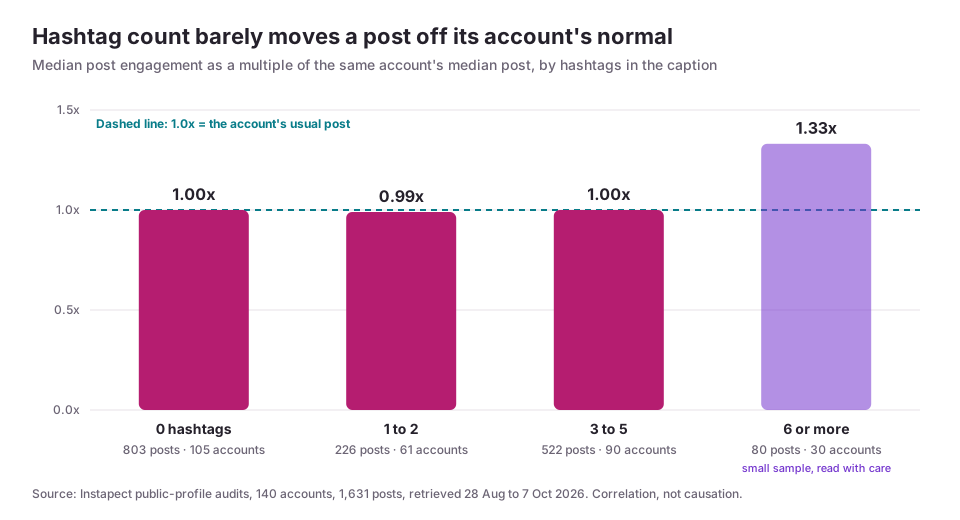
| Hashtags in caption | Posts | Accounts | Median engagement vs own account | Share above own median |
|---|---|---|---|---|
| 0 | 803 | 105 | 1.00x | 49.3% |
| 1 to 2 | 226 | 61 | 0.99x | 47.3% |
| 3 to 5 | 522 | 90 | 1.00x | 46.2% |
| 6 or more | 80 | 30 | 1.33x | 58.8% |
Instapect audits retrieved 28 August to 7 October 2026. The 6+ group is small and mostly older posts from a few heavy taggers, so treat it as noise rather than a reason to break the limit.
The sharper test is inside a single account. 39 accounts in the sample published at least 3 posts with hashtags and 3 without. For each one, Instapect divided the median engagement of the tagged posts by the median of the untagged posts.
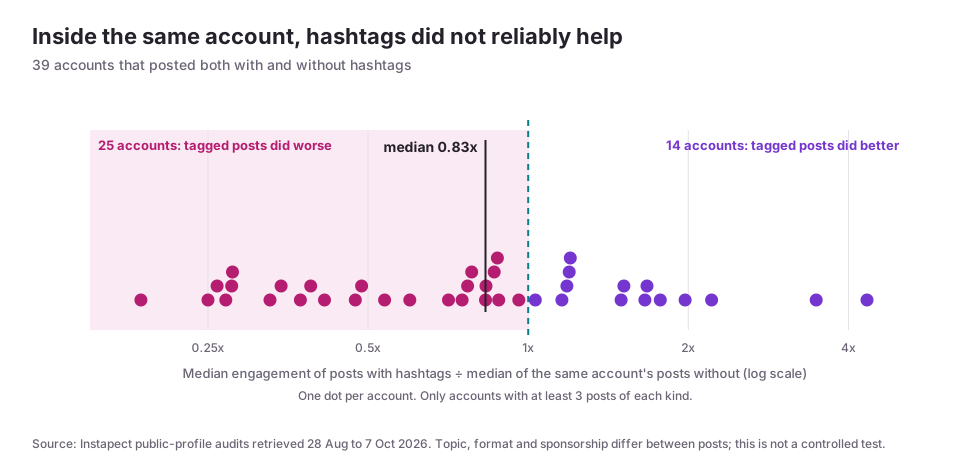
- Median ratio: 0.83x. The typical account's tagged posts earned 17% less engagement than its untagged posts.
- Tagged posts did better in 14 of 39 accounts (36%) and worse in 25.
- The spread is wide. The middle half of accounts sat between 0.39x and 1.20x. 13 accounts were below 0.5x and 8 were above 1.5x.
- The result holds under looser and stricter cuts. With at least 2 posts of each kind (59 accounts) the median was 0.88x, with tagged posts ahead in 26. Dropping posts labelled as paid partnerships left 37 accounts at 0.83x.
Three public reports show how differently this plays out:
| Account (retrieved) | Median engagement, untagged posts | Median engagement, tagged posts | Posts (untagged / tagged) |
|---|---|---|---|
| @cristiano (28 Aug 2026) | 2.02% | 0.38% | 9 / 3 |
| @nasa (5 Sep 2026) | 0.09% | 0.14% | 5 / 7 |
| @garyvee (5 Sep 2026) | 0.07% | 0.31% | 6 / 6 |
For @cristiano, the few tagged posts look like campaign posts, which rarely match a personal photo. For @nasa and @garyvee, tagged posts came out ahead. Same tactic, opposite results, because the posts differ in more ways than their tags.
Did the 5-hashtag limit change what people post?
Yes, and it is visible in public captions. Before 18 December 2025, 18.7% of the audited posts carried more than 5 hashtags. From that date on, it was 3.6%.
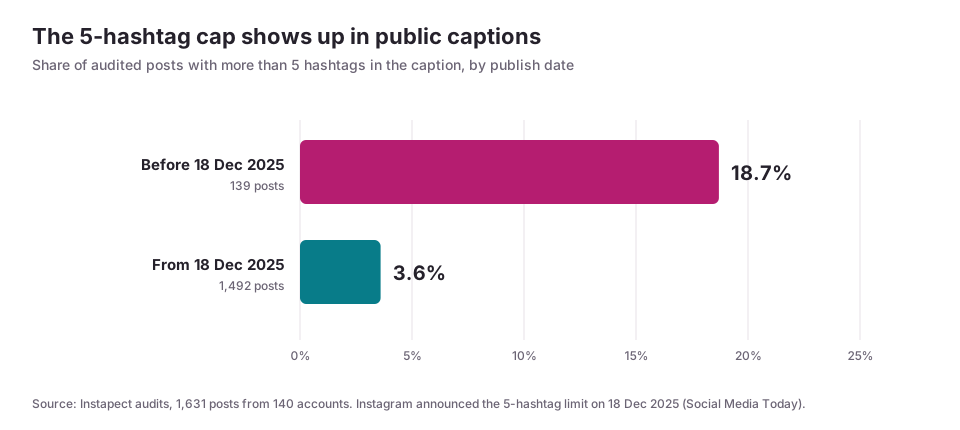
The cap is not airtight in public data. 54 posts from 13 accounts published in 2026 still show more than 5 tags in the caption. Instapect cannot see how those posts were created (app, desktop, a scheduling tool, or a caption edited later), so it reads them as signs of a gradual rollout, not as a way around the rule. Instagram's Help Center is clear that 5 is the limit.
Other habits in the sample, for context:
- 85% of accounts (119 of 140) used at least one hashtag in their sampled posts. 35 tagged every post. 21 used none.
- 51% of posts carried hashtags, averaging 4.4 tags when used.
- Reels were tagged most: 61% of Reels had hashtags, against 39% of single images and 38% of carousels.
Why do posts with hashtags often get less engagement?
Mostly because of what kind of post gets tagged, not because tags push engagement down. Metricool's 2026 Instagram Study (published 16 June 2026) compared 24,364,803 posts from 375,118 accounts across January and February 2025 and 2026, and found posts with at least one hashtag saw 31.70% fewer views and 33.89% fewer interactions than the platform average. Instapect's within-account figure (0.83x) points the same way at a much smaller scale. Neither is a controlled test.
| Study (date) | Sample | Finding on hashtags | Measured against |
|---|---|---|---|
| Metricool 2026 Instagram Study (16 Jun 2026) | 24.4M posts, 375,118 accounts | Tagged posts: 31.70% fewer views, 33.89% fewer interactions | Platform average |
| Instapect audits (28 Aug to 7 Oct 2026) | 1,631 posts, 140 public accounts | Tagged posts: median 0.83x engagement | Same account's untagged posts |
| Buffer, "How to Use Hashtags" (updated 7 Nov 2016) | Pre-cap era | Interactions highest at 11+ hashtags | Other tag counts |
Likely reasons tagged posts trail, all of which a reader can check against their own feed:
- Promotional posts attract tags. Sales, launches and event promos are the posts people tag most and audiences like least.
- Format mix. In Instapect's sample, Reels were tagged far more often than images or carousels, so tag counts partly track format.
- Generic tags add nothing. Later notes that tags like #love (2B+ posts) and #instagood (1.7B+ posts) give Instagram "almost no useful classification signal".
- Hashtag pages show few posts. A post tagged with a huge tag competes with millions of others for a small number of visible slots.
A hashtag is unlikely to hurt a good post, and it will not rescue a weak one.
How to choose your 5 Instagram hashtags
Choose tags by specificity, not popularity. Later recommends mid-sized tags with roughly 10K to 500K posts, because a post can still be seen there, over mega-tags with billions.
- Write the caption first. Put the main keyword in the first line ("Sourdough starter in 5 days"), since Instagram reads caption text for search too.
- Open Instagram search, tap the Tags tab, and type your topic. Where Instagram shows a post count, note it.
- Pick 1 or 2 niche tags that only people interested in this exact topic would search (#sourdoughstarter).
- Add 1 topic tag that is broader but still specific (#homebaking).
- Add 1 branded or location tag if it fits (#yourbakeryname or #austinbakery).
- Stop at 5. Instagram will not post more, and fewer is fine.
- Put them in the caption when you post: tap Write a caption..., type # and the word, then Share. To add tags to an existing post, tap ... on the post, then Edit.
| Tag type | Purpose | Example | How many |
|---|---|---|---|
| Niche | Reach people searching your exact topic | #sourdoughstarter | 1 to 2 |
| Topic | Tell Instagram the broader category | #homebaking | 1 |
| Branded | Collect your own and customers' posts | #yourbrandname | 0 to 1 |
| Location | Local discovery | #austinbakery | 0 to 1 |
| Generic (#love, #viral, #instagood) | None that holds up | Skip | 0 |
How to test whether hashtags work for your account
Run a 4-week split and compare medians, not single posts. The spread in Instapect's data (0.39x to 1.20x for the middle half of accounts) shows why one tagged post proves nothing.
- Pick one format, for example Reels, so format does not muddy the result.
- Alternate for 4 weeks: one post with 3 to 5 specific tags, the next with none. Aim for at least 5 posts of each kind.
- Keep everything else steady: similar topics, similar posting times (see the best time to post on Instagram for patterns).
- Check each post's Insights. On a professional account, tap View insights under the post. Note views, the split between followers and non-followers, likes, comments, shares and saves.
- Compare medians, not averages. One viral post can drag an average a long way.
How to read the result:
- Tagged posts show a higher share of views from non-followers and a median 20% or more above untagged posts → hashtags are bringing discovery for your niche. Keep them.
- The difference is under about 20% either way → within normal post-to-post noise. Keep tags only where they describe the post well.
- Tagged posts are clearly lower → check whether your tagged posts were also your promotional ones. If so, the topic, not the tag, is the likely cause.
If you only want the engagement side for any public account, the Instagram engagement rate calculator shows average and median engagement per post, and the guide on how to calculate Instagram engagement rate gives the formula for a spreadsheet. Reach and the follower/non-follower split are private, so only Instagram Insights can show them.
Common hashtag mistakes in 2026
| Mistake | Why it fails | Do this instead |
|---|---|---|
| Pasting the same 5 tags on every post | Later notes repeated identical sets can look spammy and misfile posts | Pick tags per post |
| Using #love, #instagood, #viral | Billions of posts, no classification signal | Use niche and topic tags |
| Hiding 5 tags in a comment to save caption space | The 5 slots are shared between caption and comments (Later) | Put tags in the caption |
| Expecting tags to grow a new account | Instagram says tags do not increase reach | Work on the post: hook, watch time, shares |
| Judging hashtags from one post | Normal variation is larger than the hashtag effect | Run the 4-week split |
| Tagging a private account's posts | Private posts do not appear on hashtag pages | Switch to public, or skip tags |
| Trying to beat the limit with old scheduling habits | Instagram's stated limit is 5; excess tags may block the post | Trim drafts and templates to 5 |
What hashtags, and public data, cannot tell you
Engagement is not reach. Instagram describes hashtags as a discovery and labelling tool, so their main effect, if any, shows up in reach from non-followers. That number is private. Instapect measures only public signals: posts, visible likes and comments, captions, hashtags, mentions, posting times and follower count. It does not see reach, impressions, views by source, demographics or Story data, and it cannot see private accounts.
That is why this guide treats the audit data as a check on one claim ("more hashtags means more engagement"), which it does not support, and leaves the discovery question to each account's own Insights.
Methodology and limits of the Instapect data
- Sample: 140 public Instagram accounts audited by Instapect, retrieved 28 August to 7 October 2026. Quality bar: at least 6 usable posts per account and no posts with hidden like counts. 1,631 posts in total.
- Hashtag count: every "#" followed by text in the post caption. Tags placed only in comments are not counted.
- Engagement: (likes + comments) / followers x 100 per post, compared to the median post of the same account.
- Within-account test: accounts with at least 3 tagged and 3 untagged posts (39 accounts).
- Who is in the sample: accounts that people chose to audit on Instapect, from global celebrities to local businesses. It is not a random sample of Instagram, and some groups (6+ tags, single niches) are small.
- Correlation, not causation. Tagged and untagged posts differ in topic, format and purpose. These figures describe what happened in this sample. They do not show what a hashtag would do to any single post.
Frequently asked questions
Do hashtags still work on Instagram in 2026?
Yes, as labels. They help Instagram categorise a post and let people find it on hashtag pages and in search. Instagram's leadership has said they do not increase reach, and recent data from Metricool (24.4M posts) and Instapect (1,631 posts) found no engagement lift from using them.
How many hashtags should I use on Instagram?
Between 0 and 5. Instagram's own guidance is "up to 5 more targeted hashtags". Use 3 to 5 when specific tags exist for the topic, and fewer when they would be filler. In Instapect's data, posts with 0, 1 to 2 and 3 to 5 tags all landed within about 1% of their account's typical engagement.
What is the hashtag limit on Instagram?
5 hashtags per post or Reel, according to the Instagram Help Center (checked 10 October 2026). Instagram announced the change on 18 December 2025. The previous limit was 30.
Instagram won't let me post my caption. Is it the hashtags?
Probably, if it has more than 5. The Help Center says that with more than 5 tags on a post "your comment won't post", and Later notes the limit covers caption and comments together. Cut the tags to 5 or fewer and try again. Also check for spaces or symbols like $ or % inside a tag.
My hashtags stopped bringing views. What changed?
Several things. You can no longer follow hashtags in the main feed (removed in 2024), the cap dropped to 5 in December 2025, and Instagram now reads caption keywords and the content itself for search. Broad tags also show very few posts per page. Switch to niche tags and put the main keyword in the first line of the caption.
Should I put hashtags in the caption or the first comment?
The caption. The 5-tag limit counts both together, so the comment gives you no extra room, and the caption is what Instagram reads first. Instagram's Help Center lists both as valid places, so a tag in a comment still works for hashtag pages.
I used 5 hashtags and got fewer likes than usual. Did the hashtags hurt?
Unlikely on their own. In Instapect's within-account comparison, tagged posts ranged from 0.19x to 4.3x of the same account's untagged posts, so single-post swings are normal. Check whether the tagged post was a different format or a promotional post, then test over 4 weeks before deciding.
Do hashtags work on Instagram Reels?
They work the same way: as labels for classification and hashtag search, up to 5 per Reel. In Instapect's sample, 61% of Reels carried hashtags, more than any other format. Later recommends niche and topic tags for Reels over broad mega-tags.
Are hashtags still relevant for small accounts?
Somewhat more than for large ones, because a niche hashtag page is one of the few places a stranger can find a small account. Keep them specific (local or niche), keep them to 5 or fewer, and judge them by non-follower views in Insights, not likes.
What is the 3 hashtag rule?
There is no official 3 hashtag rule. The phrase usually means using about 3 focused tags, and it gained traction in 2025, when Instagram tested a 3-tag limit with some users (Social Media Today, 18 Dec 2025). Instagram settled on 5 instead. Three strong, specific tags remain a sensible habit.
The short version
Hashtags on Instagram are labels, capped at 5 per post since December 2025. Use 0 to 5 specific tags that describe the post, put them in the caption, and do not expect them to raise engagement: across 1,631 audited posts, tag count made no reliable difference, and inside the same account tagged posts did slightly worse (median 0.83x). To find out what they do for discovery on your own account, run a 4-week tagged vs untagged test and compare non-follower views in Instagram Insights.
Related guides: best time to post on Instagram, how to calculate Instagram engagement rate, micro vs nano influencers.
Sources: Instagram Help Center, Use hashtags on Instagram (checked 10 Oct 2026); Social Media Today, Instagram Implements New Limits on Hashtag Use (18 Dec 2025); Metricool 2026 Instagram Study press release (16 Jun 2026); Later, Instagram hashtags in 2026 (21 Apr 2026); CO by U.S. Chamber of Commerce, Are Hashtags Still Relevant? (2026); Buffer, How to Use Hashtags (7 Nov 2016); Instapect public-profile audits (retrieved 28 Aug to 7 Oct 2026).