The Instagram algorithm is not one algorithm. It is a set of separate ranking systems, one each for Feed, Stories, Explore, Reels and Search, and each one predicts how likely you are to act on a post (watch it, like it, share it, comment, tap the profile) and orders content by those predictions (Instagram Ranking Explained, Adam Mosseri, checked November 12, 2026). Feed and Stories lean on your relationship with the poster; Reels and Explore lean on how popular a post is with people like you.
In Instapect's audits of 164 public accounts (1,711 recent posts), Reels were the format most likely to break out: 13.2% of Reels drew 3x or more of the account's usual likes and comments, against 10.2% of carousels and 8.9% of single images. Carousels, though, beat the account's usual post more often (58.7% of the time). That is the algorithm's shape in public numbers: Reels are tested on strangers, carousels are ranked for followers.
Disclosure: Instapect publishes this guide and makes one of the tools mentioned below. Instapect reads public signals only (posts, likes, comments, Reel plays, captions, follower counts). It cannot see reach, impressions, saves, shares, sends, watch time or anyone's Insights, so every claim here about those signals comes from Meta's own explainers, not from our data.
TL;DR: the Instagram algorithm in one table
| If you want to know... | Short answer (November 2026) | Source |
|---|---|---|
| Is there one Instagram algorithm? | No. Feed, Stories, Explore, Reels and Search each use their own ranking system | Instagram Ranking Explained (Mosseri, 2023) |
| What Feed ranks on | Your activity, information about the post, information about the poster, your history with them | Instagram Ranking Explained |
| What Reels ranks on | Predicted reshare, watch to the end, like, and visit to the audio page | Instagram Ranking Explained |
| The three signals Instagram names most | Watch time, likes per reach, sends per reach | Mosseri, January 2025 video, via Buffer |
| What makes a Reel less visible | Low resolution, watermarks, muted audio, borders, mostly text, already posted on Instagram | Instagram Ranking Explained |
| Can you change your own algorithm? | Yes. Your Algorithm (Feed, Reels, Explore) lets you add or remove topics; Reset suggested content starts fresh | About Instagram; Instagram Help Center |
| Do hashtags or posting gaps move ranking? | Not in public numbers: median 1.00x the account's usual post at 0, 1 to 2 and 3 to 5 hashtags, and at any gap since the last post | Instapect, 164 accounts |
| Which format breaks out most | Reels: 13.2% hit 3x the account's median, vs 10.2% carousels and 8.9% images | Instapect, 1,711 posts |
| Who reaches past their followers | 59% of Reels from accounts under 10K had more plays than followers; 2% at 1M+ | Instapect, 975 Reels |
What the sources agree on: Meta's explainer, Buffer, Hootsuite and Sprout Social all describe the same split. Content shown to your followers is ranked mostly on relationship and past interaction. Content shown to people who do not follow you (Reels, Explore, suggested posts) is ranked mostly on how strangers react to it. Instapect's public numbers fit that split.
- To reach people who do not follow you yet: post Reels and judge them on plays, not likes.
- To keep followers engaged: carousels win most often against the account's own baseline.
- To fix what you see as a viewer: use Your Algorithm or Reset suggested content (steps below).
What is the Instagram algorithm?
The Instagram algorithm is the name people use for the ranking systems that decide what each person sees and in what order. In Meta's words, "Instagram doesn't have a singular algorithm that oversees what people do and don't see on the app. We use a variety of algorithms, classifiers, and processes, each with its own purpose" (Instagram Ranking Explained, May 31, 2023).
Every ranker follows the same three steps:
- Gather candidates. Feed starts from recent posts by accounts you follow plus suggested posts; Reels and Explore start from content you are likely to enjoy, mostly from accounts you do not follow.
- Score each candidate. Instagram reads "signals" (Meta says there are thousands) about the post, the poster and you, then predicts how likely you are to take each action.
- Sort and filter. Higher predicted interest ranks higher. Integrity rules apply on top: posts that break the Community Standards are removed, and posts that break the Recommendation Guidelines are not recommended to non-followers.
Meta publishes a "system card" for each ranker in its Transparency Center, which lists the predictions and the main signals in more detail.
How the Instagram Feed algorithm works
Feed mixes posts from accounts you follow, suggested posts and ads. Meta lists the most important Feed signals "roughly in order of importance" (Instagram Ranking Explained):
| Rank | Feed signal | What it means |
|---|---|---|
| 1 | Your activity | Posts you have liked, shared, saved or commented on |
| 2 | Information about the post | How popular it is and how quickly people like, comment, share and save it, plus when it was posted and any location |
| 3 | Information about the person who posted | How many times people have interacted with them in the past few weeks |
| 4 | Your history with that person | For example, whether you comment on each other's posts |
From those signals Feed makes roughly a dozen predictions. The five it weighs most are how likely you are to spend a few seconds on the post, comment on it, like it, share it, and tap the profile photo. Feed also avoids showing too many posts from one account, or too many suggested posts, in a row.
What this means for an account: your followers see you first when they already interact with you. Replies to comments, DMs and Story conversations all count as "history with that person". If you want to see how often your followers respond, the engagement rate guide has tier benchmarks.
How the Instagram Reels algorithm works
Reels is built for discovery and entertainment, and most of what you see there comes from accounts you do not follow. Meta says it surveys people on whether a Reel was "worth their time" and trains on the answers. The predictions it weighs most are how likely you are to reshare the Reel, watch it all the way through, like it, and go to the audio page (a proxy for wanting to make your own).
The most important Reels signals, roughly in order of importance:
- Your activity: Reels you have liked, saved, reshared, commented on and engaged with recently.
- Your history with the poster: usually none, which is why stranger reactions matter so much.
- Information about the Reel: the audio, the visuals and its popularity.
- Information about the poster: popularity signals such as follower count or engagement level, used "to give everyone a chance to find their audience".
Meta also names what makes a Reel less visible: low resolution, watermarks (for example from another app), muted audio, borders, Reels that are mostly text, and Reels already posted on Instagram. The Reel making guide covers how to post one cleanly, and the Reel length guide covers the 3 minute limit for recommendations to non-followers.
The three signals Mosseri names
In a January 2025 video, Instagram head Adam Mosseri named three signals as the most important across the app: watch time, likes per reach and sends per reach (DM shares divided by accounts reached). He said likes count slightly more for reaching followers and sends count slightly more for reaching people who do not follow you (Mosseri's video, summarised by Buffer, October 23, 2026). Instagram has not published exact weights, so any post claiming "a send is worth 5 likes" is guessing.
You can see your own watch time, reach and shares in Instagram Insights. Instapect cannot, because none of those numbers are public.
How the Instagram Stories algorithm works
Stories come only from accounts you follow (plus ads), so ranking is about relationship. Meta lists three input signals (Instagram Ranking Explained):
- Viewing history: how often you watch that account's Stories.
- Engagement history: how often you engage with them, such as sending a like or a DM.
- Closeness: your overall relationship and how likely you are to be friends or family.
From those, Instagram predicts whether you will tap into a Story, reply to it, or move on to the next one. Stories do not reach new people on their own; they keep the people who already follow you close. Stickers such as polls and questions give viewers one more way to interact, which feeds the engagement history signal.
How the Instagram Explore algorithm works
Explore is a grid of recommendations from accounts you do not follow yet. The actions it predicts most are likes, saves and shares, and its signals, in rough order of importance, are:
- Information about the post: how many people, and how quickly, are liking, commenting, sharing and saving it. Meta says these popularity signals "matter much more in Explore than they do in Feed or in Stories".
- Your activity in Explore: what you have liked, saved, shared or commented on there.
- Your history with the poster.
- Information about the poster: how many times people have interacted with them in the past few weeks.
Explore, Reels, Search and suggested posts all apply the Recommendation Guidelines. If an account repeatedly breaks them, "none of their posts will be eligible for recommendation for a period of time". You can check this in Account Status in your profile settings before assuming anything else is wrong.
What changed in the Instagram algorithm in 2025 and 2026?
| Change | When | What it does | Source |
|---|---|---|---|
| Three named signals: watch time, likes per reach, sends per reach | January 2025 | Gives creators three ratios to watch in Insights | Mosseri video, via Buffer |
| Your Algorithm launches on Reels | December 10, 2025 (US first) | Shows the topics Instagram thinks you like; you can ask for more or less of any topic | About Instagram |
| Your Algorithm expands to Explore | April 15, 2026 | One shared topic list for Reels and Explore | About Instagram |
| Your Algorithm live across Feed, Reels and Explore | 2026, globally in English | Change a topic once and it applies everywhere | About Instagram |
| Less reach for aggregator accounts that mostly repost others' work | Reported from April 2026 | Original creators get the distribution, not the reposter | Buffer, citing Mosseri |
The practical effect of Your Algorithm for creators: viewers can now ask to see a topic less. Accounts that stay on a clear topic, and name it in captions and on-screen text, are easier for Instagram to match with people who chose that topic.
What 1,711 audited posts show about the Instagram algorithm
Instapect cannot see Instagram's ranking signals. It can see what the algorithm leaves behind in public numbers: likes, comments and Reel plays on each post. To test the common claims, we took every public profile audited between August 28 and November 10, 2026 that met our quality bar (not delisted, at least 6 recent posts, no hidden likes, followers above zero), kept the latest audit per account, and dropped pinned posts. That left 164 accounts and 1,711 recent posts. Each post is compared with its own account's median likes plus comments, so a 1.00x post did exactly as well as that account usually does.
Reels break out more often; carousels beat the baseline more often
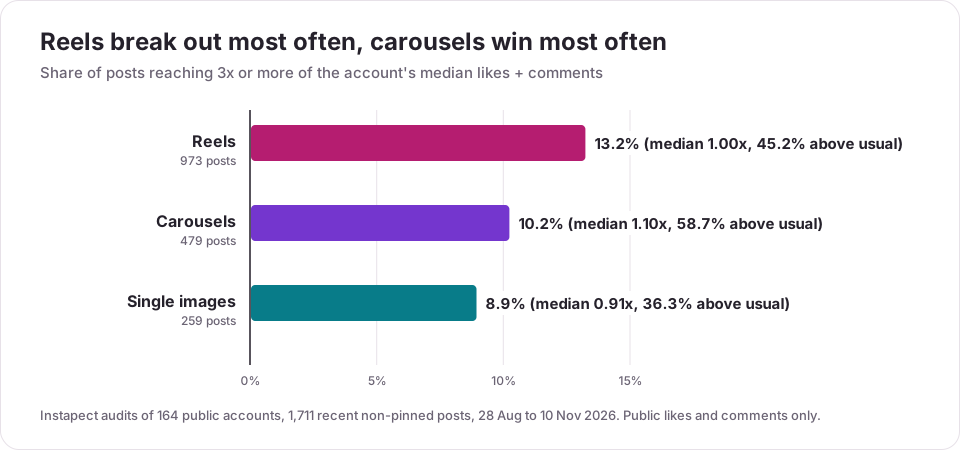
| Format | Posts | Accounts | Median vs account's usual | Beat the account's usual | 3x or more (breakout) | Half or less |
|---|---|---|---|---|---|---|
| Reels | 973 | 155 | 1.00x | 45.2% | 13.2% | 17.9% |
| Carousels | 479 | 109 | 1.10x | 58.7% | 10.2% | 9.8% |
| Single images | 259 | 89 | 0.91x | 36.3% | 8.9% | 23.6% |
| All posts | 1,711 | 164 | 1.00x | 47.6% | 11.7% | 16.5% |
Reels have the widest spread: the most breakouts and, after images, the most flops. That matches how Meta describes Reels ranking, where a Reel is shown to people who do not follow you and lives or dies on their reaction. Carousels are steadier because they are mostly ranked for followers who already interact with you. Buffer's analysis of more than 4 million posts found the same trade from the other side: Reels got 36% more reach than carousels, and carousels got 12% more engagement than Reels. The carousel guide has the same-account comparison by tier.
Small accounts reach past their followers far more often
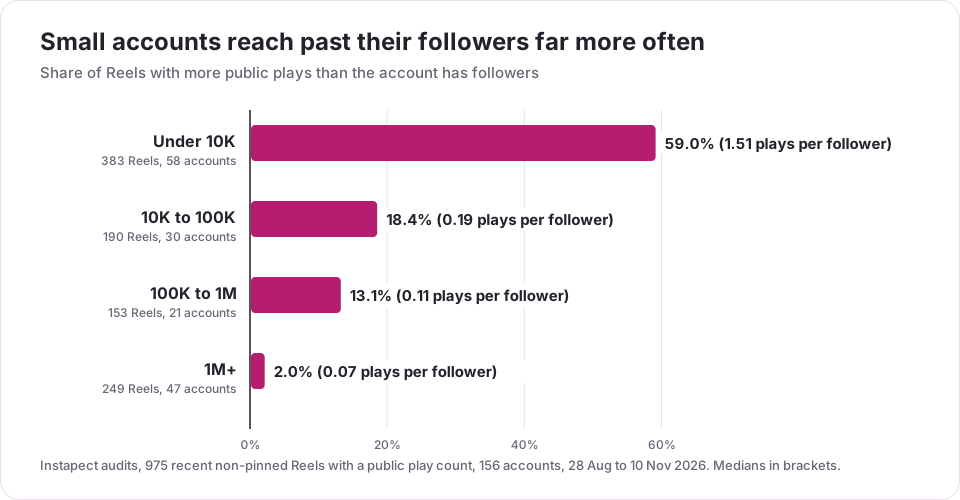
Reels show a public play count, so we can compare plays with the account's follower count. A Reel with more plays than the account has followers must have reached non-followers, because even if every follower watched it once, the number would not get that high.
| Followers | Reels | Accounts | Median plays per follower | Reels with more plays than followers |
|---|---|---|---|---|
| Under 10K | 383 | 58 | 1.51 | 59.0% |
| 10K to 100K | 190 | 30 | 0.19 | 18.4% |
| 100K to 1M | 153 | 21 | 0.11 | 13.1% |
| 1M and above | 249 | 47 | 0.07 | 2.0% |
| All | 975 | 156 | 0.31 | 29.3% |
This supports Meta's line that poster popularity is used "to give everyone a chance to find their audience". A small account does not need its followers to see a Reel for it to travel. A very large account rarely gets more plays than its follower count simply because that count is so high.
Hashtag count and posting gap barely move the needle
| What we checked | Bucket | Posts | Median vs account's usual | Breakout share (3x+) |
|---|---|---|---|---|
| Hashtags in caption | 0 | 863 | 1.00x | 12.2% |
| 1 to 2 | 226 | 1.00x | 11.1% | |
| 3 to 5 | 555 | 1.00x | 10.5% | |
| 6 to 10 | 47 | 1.08x | 21.3% | |
| 11 or more | 20 | 0.97x | 10.0% | |
| Days since the account's previous post | Under 1 | 578 | 1.00x | 12.8% |
| 1 to 3 | 420 | 1.00x | 11.7% | |
| 3 to 7 | 262 | 1.00x | 11.5% | |
| 7 to 14 | 124 | 1.02x | 11.3% | |
| 14 or more | 163 | 1.00x | 8.6% |
The typical post did exactly as well as the account's usual post whether it had zero hashtags or five, and whether it came a day or two weeks after the last one. The 6 to 10 hashtag row looks better, but it rests on 47 posts, so treat it as noise until the sample grows. Long gaps did come with fewer breakouts (8.6% after 14+ days), which fits recency being a Feed signal. Instagram now allows up to 5 hashtags per post or Reel (Instagram Help Center), so the 6+ rows will keep shrinking; the hashtag study and the posting frequency guide go deeper.
Breakouts are not driven by comments
Breakout posts drew a median 1.33 comments per 100 likes, against 1.44 for every other post. The posts that spread did not get there by collecting more comments per like. That lines up with Mosseri naming watch time, likes and sends as the top three signals, not comments.
Three public examples
- @natgeo (268.7M followers, audited August 28, 2026): its best recent Reel drew 6.05x the account's median likes and comments, and its best carousel 8.42x. Big accounts still get breakouts in both formats.
- @khaby00 (78.0M followers, audited August 28, 2026): all 12 recent posts were Reels, and the best one drew 9.04x the account's median. A Reel-only account lives on breakouts.
- @kingjames (153.9M followers, audited September 5, 2026): carousels ran at a median 3.86x the account's usual post, Reels at 0.23x. On this account the followers who like photo dumps outweigh the strangers who watch Reels.
Limits of this data: the accounts are the ones people chose to audit on Instapect, not a random sample, and the 1M+ tier is over-represented by famous accounts. Likes and comments are public outcomes, not the signals Instagram ranks on (watch time, sends and reach are private). Reel play counts are Instagram's public number, which counts repeat views. Small tiers (for example 21 accounts at 100K to 1M) can swing with a few posts.
How to work with the Instagram algorithm
- Pick the surface first. Want new followers? Make Reels and judge them on plays. Want existing followers to respond? Carousels beat the account's usual post 58.7% of the time in our data.
- Win the first seconds of a Reel. Watch time is one of the three named signals, and completion is one of the main Reels predictions. Put the point in the opening frame.
- Make it worth sending. Sends per reach is the signal Mosseri ties to reaching non-followers. Tutorials, lists and specific, relatable posts get forwarded.
- Post original, clean files. No watermarks from other apps, no borders, sound on, and not a re-upload of something already on Instagram.
- Stay on one topic. With Your Algorithm, viewers pick topics. A clear topic in captions and on-screen text makes your posts easier to match.
- Talk to your followers. Feed and Stories rank on your history with each viewer. Reply to comments and Story replies.
- Check Account Status before blaming a penalty. It shows whether your account is eligible for recommendations and lets you appeal.
- Audit your own baseline. Compare each post with your own median, not with other accounts. You can do this with a spreadsheet, in Insights, or with a free public audit in the Instagram profile analyzer.
How to reset or control your own Instagram algorithm
Tune it with Your Algorithm (Feed, Reels and Explore):
- Open Reels or Explore.
- Tap the icon in the upper right (two lines with hearts). You can also go to Settings and activity > Content preferences > Your algorithm.
- Review the topics Instagram thinks you like, then add topics you want more of or less of.
Start fresh with Reset suggested content:
- Go to your profile and tap the menu (three lines).
- Open Settings and activity > Content preferences.
- Tap Reset suggested content, review the accounts you follow, then confirm.
Resetting does not change who you follow or the ads you see, and it does not delete your data; Instagram re-learns your interests from new likes, shares and interactions (Instagram Help Center, checked November 12, 2026). Tapping Not interested on a suggested post is the lighter option.
Common Instagram algorithm mistakes to avoid
- Treating it as one algorithm. A post that flops in Feed can still travel in Reels. Judge each surface on its own numbers.
- Judging Reels on likes per follower. Reels go mostly to strangers, so plays tell you more. In our data the median Reel at 1M+ followers got 0.07 plays per follower, yet that says nothing about whether it was recommended.
- Reposting other people's work. Meta lowers the visibility of Reels already posted on Instagram, and accounts that mostly repost lose reach to the original creators.
- Stuffing hashtags. Zero, two or five hashtags all landed at 1.00x the account's usual post in our audits.
- Buying engagement or followers. Bought followers do not watch or send your posts, so your likes per reach and sends per reach fall.
- Deleting and reposting a flop. A re-upload counts as content already on Instagram. Work out why it missed and make a better post.
- Assuming a shadowban. Check Account Status first. Meta says it does not suppress content to sell ads. The Instagram shadowban guide walks through the check, the fixes and how often normal dips happen.
Frequently asked questions
How does the Instagram algorithm work in 2026?
Instagram runs separate ranking systems for Feed, Stories, Explore, Reels and Search. Each gathers candidate posts, predicts how likely you are to watch, like, share, comment or tap the profile, and orders posts by those predictions. Feed and Stories lean on your relationship with the poster; Reels and Explore lean on how popular a post is with people like you.
What are the most important Instagram ranking signals?
Adam Mosseri has named three: watch time, likes per reach and sends per reach. Likes count slightly more for reaching followers and sends count slightly more for reaching non-followers. Meta's 2023 explainer adds your activity, information about the post, information about the poster and your history with them.
Does the Instagram algorithm favor Reels?
Reels are the main way to reach people who do not follow you, because the Reels tab is mostly recommendations. In Instapect's audits, 13.2% of Reels drew 3x or more of the account's usual likes and comments, the highest of any format. Carousels, though, beat the account's usual post more often (58.7% vs 45.2%).
Why did my Instagram reach suddenly drop?
The usual causes are a post that did not hold attention, a change of topic that makes Instagram re-learn your audience, or a long gap between posts. Check Account Status in your settings to rule out a recommendation restriction, and check Insights for watch time and the share of reach from non-followers.
Does the algorithm show my posts to only 10% of my followers?
No. Meta has never said that, and the Feed explainer describes ranking every candidate post for every follower by predicted interest. Some followers see a post high in Feed, others further down or not at all in that session, depending on how they interact with you.
My Reel got zero views. Is my account shadowbanned?
A Reel stuck near zero is usually a processing issue, a Recommendation Guidelines problem, or a file Instagram treats as low quality (watermark, borders, muted audio, mostly text). Open Account Status to see whether your content is eligible for recommendations and appeal if it is not. Meta says it does not hide content to push people into buying ads.
Do hashtags still help with the Instagram algorithm?
They help Instagram understand the topic, but they are not a ranking boost. In 1,711 audited posts, the typical post with 0, 1 to 2 or 3 to 5 hashtags all drew 1.00x the account's usual likes and comments. Instagram now allows up to 5 hashtags per post or Reel.
Does posting time affect the Instagram algorithm?
Recency is a Feed signal, so posting when your followers are online helps a post collect early reactions. It is one factor, not the main one. Our best time to post study found the day of the week moved engagement far less than the format did.
How do I reset my Instagram algorithm?
Go to your profile, tap the menu, open Settings and activity, then Content preferences, and tap Reset suggested content. It clears what Instagram has learned for recommendations across Explore, Reels and Feed without changing who you follow or deleting data.
What is Your Algorithm on Instagram?
Your Algorithm is a screen that shows the topics Instagram thinks you are interested in and lets you ask for more or less of any topic. It launched on Reels on December 10, 2025, expanded to Explore on April 15, 2026, and now covers Feed, Reels and Explore globally in English.
Can a small account beat the Instagram algorithm?
Small accounts have an easier time reaching past their followers. In Instapect's audits, 59% of Reels from accounts under 10K followers got more plays than the account has followers, against 2% for accounts with 1M or more. Meta says poster popularity is used to give everyone a chance to find their audience.
Can Instapect show me how the algorithm ranks my posts?
No. Instapect reads public numbers only: likes, comments, Reel plays, captions, posting times and follower counts. It shows how each post did against your own median, which is the outcome of ranking, but it cannot see reach, watch time, sends or saves. Those are only in Instagram Insights.