An Instagram competitor analysis compares your account with 3 to 5 accounts of a similar size on the same public numbers: engagement rate, the median post, comments per 100 likes, posting frequency, format mix and top posts. You can do it free by auditing each public handle in the box above and putting the results in one table. The part most guides skip is size: in 195 public profiles audited on Instapect between August 28 and November 25, 2026, the top quarter of accounts with 10K to 100K followers had a typical post 23.5 times stronger than the bottom quarter of the same tier, so a competitor only tells you something when it sits in your follower band.
Disclosure: Instapect publishes this page and makes the audit tool on it. Every step below also works by hand from the public profiles, and the guides from Sprout Social, Supermetrics, Metricool and Socialinsider cover the paid dashboards.
TL;DR: Instagram competitor analysis in one table
| If you want to know... | Short answer (November 2026) | Source |
|---|---|---|
| What to compare | Engagement rate by followers, the median post, comments per 100 likes, posts per week, format mix, top posts | Public profile data |
| How many competitors | 3 to 5 accounts within roughly 0.5x to 2x your follower count | Instapect method |
| Why size matters | Same-tier accounts differ 4.5x (1K to 10K) to 23.5x (10K to 100K) between the top and bottom quarter | Instapect, 195 accounts |
| Average or median | Use both. The average is pulled up by one viral post; the median is the typical post | Instapect method |
| What no outside tool can see | Reach, impressions, saves, shares, Story views, audience demographics | Owner-only in Instagram Insights |
| Cost | Free profile summary with no login; 2 free detailed scans after signup; $5 one-off for a PDF and one extra scan; Pro $19 a month for 50 detailed reports | Instapect pricing, checked November 26, 2026 |
- Fastest free method: audit each handle in the box above, copy the six numbers into a sheet, then compare against your own audit.
- Best for ongoing tracking of many accounts: a paid dashboard (Sprout Social, Socialinsider, Metricool) that stores history daily.
- Best for your own reach and audience: Instagram Insights, which no competitor tool can see into.
How to do an Instagram competitor analysis in 5 steps
- Pick 3 to 5 competitors your size. Search your niche keyword in Instagram's search, open the Accounts tab, and check the "Suggested for you" list on a known competitor's profile. Keep accounts with 0.5x to 2x your follower count.
- Audit each public handle. Paste each handle into the box at the top of this page. Private accounts cannot be audited by any outside tool because their posts are hidden.
- Record six numbers per account. Engagement rate by followers, median engagement rate, comments per 100 likes, posts per week, format mix (Reels, carousels, photos) and the top post.
- Compare against the tier, not just each other. Use the benchmark tables below to see whether a competitor is strong for its size or just bigger.
- Copy what works, then re-check in 30 days. Look at the formats and topics behind each competitor's top posts, test one change, and audit again a month later.
The six numbers that make a fair comparison
| Metric | Formula | Why it matters | Trap to avoid |
|---|---|---|---|
| Engagement rate by followers | (likes + comments) ÷ followers × 100, per post | Puts accounts of different sizes on one scale | Comparing it across tiers: small accounts always score higher |
| Median engagement rate | The middle post of the sample | Shows the typical post | Using only the average, which one viral post can double |
| Comments per 100 likes | comments ÷ likes × 100 | Separates conversation from passive likes | Giveaway posts inflate it |
| Posts per week | posts in the sample ÷ weeks covered | Shows how much effort sits behind the numbers | Pinned posts stretch the gap if counted |
| Format mix | Share of Reels, carousels and photos | Shows what the competitor bets on | Assuming the most-used format is the best one |
| Top post | Highest engagement in the sample | Shows the ceiling and the topic that hit it | Treating one outlier as the strategy |
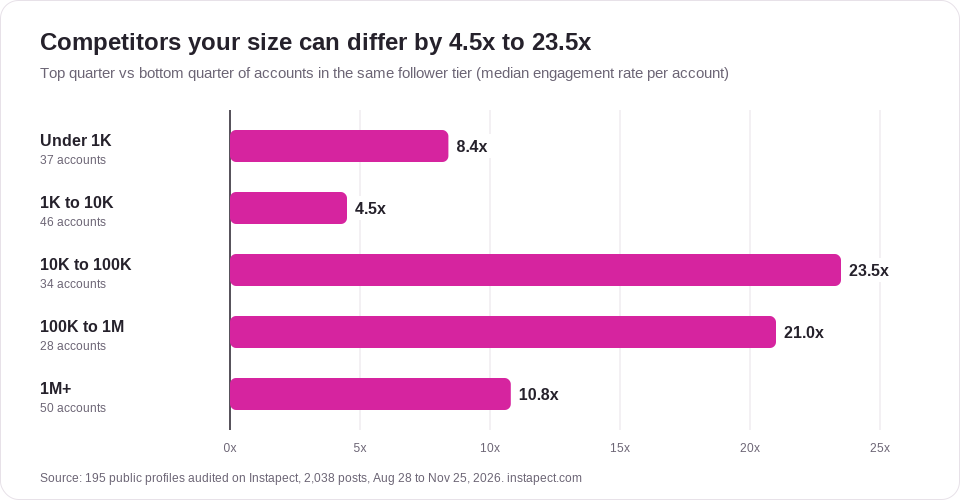
Benchmarks: where a competitor sits in its tier
Sample and method. 195 public Instagram profiles audited on Instapect between August 28 and November 25, 2026, with 2,038 recent posts. Quality filter: report not delisted, full report, at least 6 posts with visible like counts, no posts with hidden likes, followers above zero; pinned posts excluded from post-level numbers. Values are each account's median post engagement rate by followers. Read November 26, 2026.
| Follower tier | Accounts | Bottom quarter | Median account | Top quarter | Top vs bottom |
|---|---|---|---|---|---|
| Under 1K | 37 | 2.52% | 10.58% | 21.19% | 8.4x |
| 1K to 10K | 46 | 0.75% | 2.07% | 3.34% | 4.5x |
| 10K to 100K | 34 | 0.07% | 0.27% | 1.68% | 23.5x |
| 100K to 1M | 28 | 0.08% | 0.46% | 1.68% | 21.0x |
| 1M+ | 50 | 0.07% | 0.33% | 0.78% | 10.8x |
A competitor at or above the top quarter of its tier is worth studying closely. One below the bottom quarter is bigger than you, not better.
Conversation and effort by tier. The same sample, median account:
| Follower tier | Comments per 100 likes | Posts per week |
|---|---|---|
| Under 1K | 7.0 | 1.7 |
| 1K to 10K | 5.5 | 1.6 |
| 10K to 100K | 2.6 | 4.1 |
| 100K to 1M | 3.0 | 3.8 |
| 1M+ | 1.1 | 2.3 |
If a competitor in your tier posts twice as often as the median and still sits in the bottom quarter, frequency is not what it is missing.
Worked example. Two public reports with about 24,000 followers each: @ssannyue (25,586 followers, audited October 27, 2026) had a median post at 6.95% engagement, while @missyqiqi (23,957 followers, audited September 28, 2026) had a median post at 0.20%. Same size, about 34 times the likes and comments on a typical post. A follower count alone would have ranked them as equals.
Which formats to copy from a competitor
A competitor's most-used format is not always its best one. For each account we compared the median post of each format with the account's own median post.
| Format | Accounts using it | Median post engagement | Accounts where it beat their own median |
|---|---|---|---|
| Carousel | 131 | 1.30% | 63% |
| Reel | 181 | 0.89% | 34% |
| Photo | 109 | 0.80% | 27% |
Reels are the most common format in the sample, yet carousels beat the account's own typical post far more often. When a competitor's carousels outperform its Reels, that is a cheaper format to test than a new Reel series.
What a public competitor analysis cannot tell you
Instapect and every other outside tool read public signals only. They cannot see a competitor's reach, impressions, saves, shares, Story views, audience demographics or who viewed a profile; those are visible only to the account owner in Instagram Insights. Some paid dashboards show reach for competitors; treat those figures as the vendor's estimate, not Instagram's number. No public tool can prove that a competitor bought followers either; it can only flag patterns, such as a very low median against a large follower count, that are worth a closer look.
For a single account in depth, including pinned-post handling and the bio check, use the Instagram profile analyzer.
Mistakes to avoid
- Comparing against a much bigger account. A 500K account will almost always have a lower engagement rate than a 20K account. Stay within 0.5x to 2x your size.
- Reading only the average. In the 10K to 100K tier the average of account medians is 1.72%, but the median account sits at 0.27%: a few strong accounts pull the average up. The same happens inside one account when a single post goes viral.
- Copying the format without the topic. A competitor's top Reel may have won on its subject, not its format.
- Benchmarking once. Audit again after 30 days; a single sample covers only the most recent posts.
Frequently asked questions
What is an Instagram competitor analysis?
It is a side-by-side comparison of your Instagram account with similar accounts on public numbers such as engagement rate, posting frequency, format mix and top posts, to see what works in your niche and where you stand.
How do I do an Instagram competitor analysis for free?
Audit each competitor's public handle in the box at the top of this page, record engagement rate, median post, comments per 100 likes, posts per week and format mix, then compare with an audit of your own account. The free profile summary needs no login.
How many competitors should I analyze on Instagram?
Three to five is enough. Pick accounts with 0.5x to 2x your follower count in the same niche, because engagement rates fall as accounts grow.
What metrics should I compare with competitors on Instagram?
Engagement rate by followers, the median post, comments per 100 likes, posts per week, format mix and top posts. Follower count alone is a weak signal: in the 10K to 100K tier the top quarter of accounts had a typical post 23.5 times stronger than the bottom quarter.
Can I see a competitor's Instagram reach or impressions?
No. Reach, impressions, saves, shares and Story views are visible only to the account owner in Instagram Insights. Any tool that claims to show them for someone else's account is estimating.
What is a good engagement rate compared to competitors?
It depends on the tier. In Instapect audits the median account had 2.07% at 1K to 10K followers and 0.27% to 0.46% above 10K. Being in the top quarter of your tier is a stronger result than beating one specific competitor.
Why does the audit say the account cannot be analyzed?
The account is private, the handle is misspelled, or Instagram did not return its posts at that moment. Check the handle on Instagram, and try again a few minutes later if the profile is public.
Why do two tools show different numbers for the same competitor?
They use different post windows, average versus median, views versus followers, and some count pinned posts. Compare numbers from the same tool and the same method.
Is it legal to analyze competitors on Instagram?
Looking at public profile data is what any visitor can do in the app. Respect Instagram's terms, do not scrape private data, and do not copy competitors' content.
How often should I run an Instagram competitor analysis?
Monthly is enough for most accounts, and after any big change in your own content strategy so you can see whether it moved your position in the tier.